What We Would Tell Our 15-Year-Old Selves About Periods
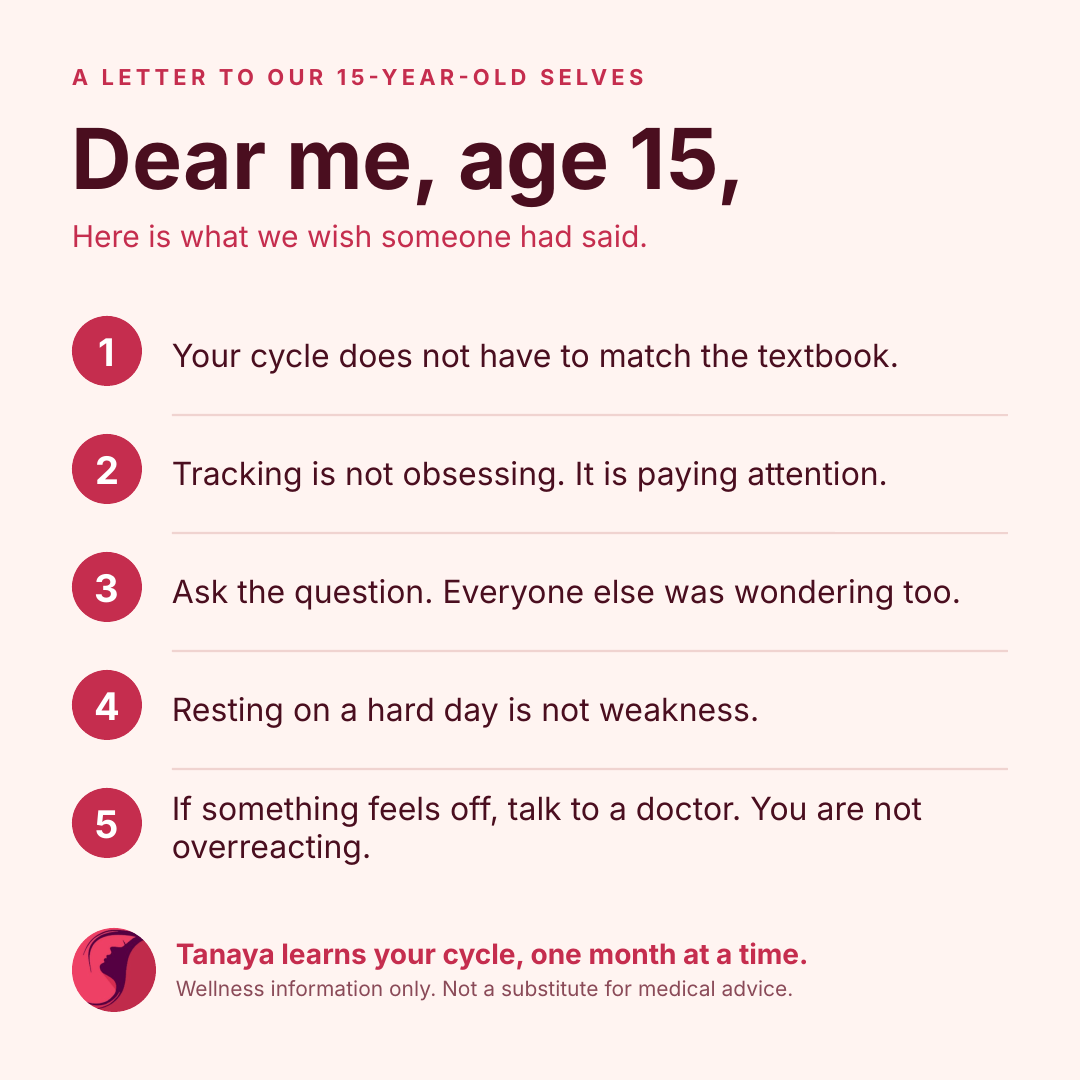
Most of us learned about periods in a rush: a single class, a leaflet, a whispered conversation. Years later, many of us still have questions we never asked. So here is a letter to our 15-year-old selves, with five things we wish someone had said.
1. Your cycle does not have to match the textbook
Textbooks talk about a 28-day cycle because averages are easy to print. Real cycles vary from person to person, and often from month to month for the same person. A cycle that looks different from the diagram is not automatically a problem. What matters most is what is normal for you, and whether that changes.
2. Tracking is not obsessing. It is paying attention
Writing down when your period starts, how long it lasts and how you feel is not about being anxious. It is about knowing your own pattern. After a few months, you stop guessing. You know roughly what to expect, and you notice sooner when something is different. It also makes any future conversation with a doctor easier, because you can share facts instead of trying to remember.
3. Ask the question
Whatever you are wondering about, someone else in the room was wondering too. Questions about pain, flow, moods, hygiene or timing are all normal questions. Find a person you trust, whether that is a parent, an older sibling, a friend or a doctor, and ask. Reliable information beats a late-night search every time.
4. Resting on a hard day is not weakness
Some days are heavier, slower or more tiring than others. Energy and mood often shift across the cycle, and it is fine to plan around that. A warm drink, an earlier night, a lighter schedule: these are sensible choices, not excuses.
5. If something feels off, talk to a doctor
You are not overreacting. If your periods are very painful, unusually heavy, suddenly irregular, or simply worrying you, speak to a doctor. You do not need to wait until it is "bad enough." A cycle history with dates and notes helps that conversation.
How Tanaya helps
Tanaya is a women's wellness companion that helps you understand your own cycle, one month at a time. It offers period tracking with AI-assisted predictions and reminders, a personal wellness profile, monthly wellness summaries you can share with your doctor, a 24/7 AI wellness assistant, and consultations with certified gynecologists, all in eight languages.
You can get Tanaya on Google Play.
Tanaya is a wellness information app and does not provide medical advice. For any health concern, please consult a qualified doctor.